
Independence Day
A Personal Reflection

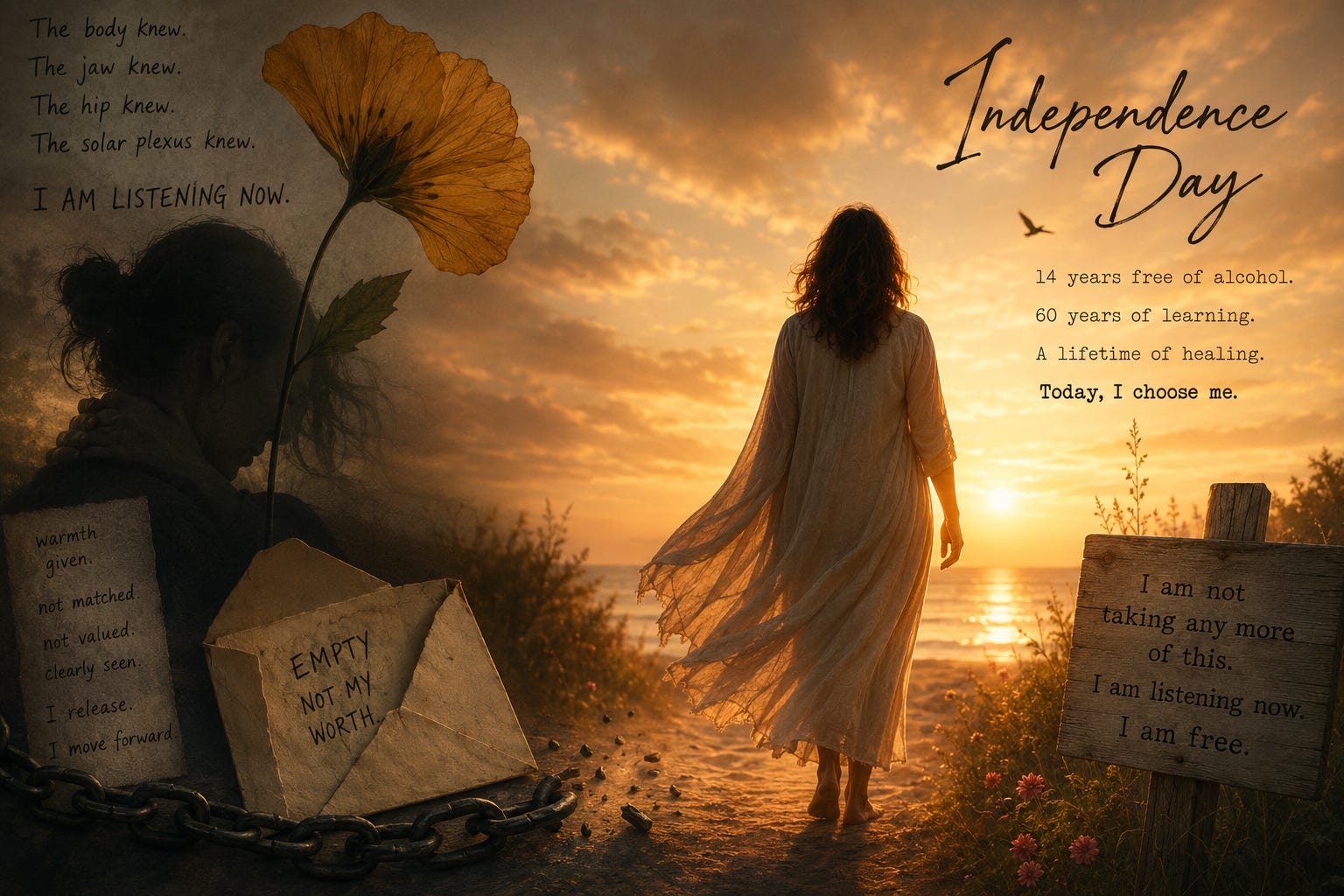
The 4th of July has a particular resonance for me this year. Not because I am American — I am not — but because today, on this date, I am claiming my own version of independence. Two days ago I marked fourteen years of being free of alcohol. And today I am putting down the last of something else entirely — a pattern that has taken sixty years and a great deal of hard-won clarity to finally see and name.
Christmas has always carried a particular weight for me. Not the weight of nostalgia or overindulgence or family chaos in the way it might for others, but something quieter and more fundamental — the weight of absence. When you grow up in a home where care is conditional, where acknowledgement is withheld, where the adults around you are so consumed by their own unprocessed pain that a child’s needs become invisible, the season that promises warmth and belonging becomes instead a yearly reminder of everything that was never there. I have spent decades learning to sit with that, to metabolise it, to find my own meaning in the turning of the year. And largely I have. But the body keeps its own calendar, and Christmas remains a threshold where old wounds can surface with surprising freshness.
On the sixteenth of December last year, someone I had known for five years said something to me about my book. I had been visiting her shop every three weeks or so, usually after finishing my shift at the trauma clinic just under a mile away in Swiss Cottage. I would go in, collect my product, take some photographs, and post them on Facebook, tagging her business on occasion — something she had specifically asked me to do, and something I did gladly because I was warm toward her and wanted to support what she was building. Over five years of that rhythm, from online orders during the pandemic through to regular visits from 2021, something that felt like genuine connection had developed. She knew something of my history. She knew about my work. She knew I had no family in the conventional sense. And on the sixteenth of December she looked at me and said, are you stupid? I thought you were intelligent. Who’s going to read your book?
I went very quiet. Not because I had no response but because I was in shock. The book she was dismissing represents years of lived experience, professional immersion in trauma work, and the deepest creative and therapeutic undertaking of my life. Thirty minutes later she said she’d like a copy. I said, gently and honestly, that it wasn’t really for friends — it was for people who had experienced childhood abuse and needed support. I meant it. I went home. I got sick for three weeks over Christmas and into the new year. She never called.
What followed was six months of something I can only describe as a slow accumulation of confirmation. A generic AI-generated Christmas message wishing love to me and those I hold dear, sent by someone who knew I had no family, no one to hold dear in the conventional sense. Silence until March, when she reached out to say she’d been meaning to check on me, that things had been chaotic, that she missed me. No mention of December. No acknowledgement that anything had passed between us that needed addressing—just a warm reentry as though the wound had not been inflicted. I responded with kindness, as I tend to do. I apologised for being in my own world. I arranged to collect my artwork from her shop — nine months of my paintings displayed on her products, used as part of her product presentation without a word. In July the reason they went there in 2025 was because she had this brilliant idea that she was going to help me sell my paintings.
She wasn’t there when I arrived. A handwritten note on the door addressed to Dear Valued Customer. I had told her I was coming four days before. I came back. She huffed and gave me a dirty look. My artwork was still on the shelves and not ready to be taken. I asked after her mother, whom I knew had been unwell. She snapped at me. I packed my things into a bag and left as quickly as I could. She said good luck as I went, in a voice that made the words mean something else entirely.
I kept ordering online. I told myself it was just a shop, just a transaction, just a product I needed. But every time I placed an order, my body registered something my mind was trying to smooth over. A low-level dread. A tightness. A wish that it could all just be simple and clean.
Then, on a Friday evening, the end of June last week, I came home and found an envelope on the floor of my communal hallway. It had been opened. It was empty. I had paid nearly sixty pounds for what should have been inside it. I reported it immediately, politely, with photographs and tracking information and every detail a reasonable person could provide. What followed was eight days of missed calls, voice messages, deleted messages, and emails that placed the responsibility back onto me entirely. Before any replacement would be sent, I was told I needed to return the empty envelope. Five years of loyal custom, nearly sixty pounds outstanding, and the empty envelope had to come first. I was expected to travel to her shop in person to hand it over and collect my goods. I kept everything in writing, held my ground, posted the envelope back by recorded delivery, and sent the proof of postage. I did everything correctly. I am still waiting for my product.
But what I want to write about is not the consumer dispute. What I want to write about is what happened in my body.
The jaw that locked tight. The chest that felt compressed. The solar plexus that carried the impact of every message like a physical blow. The tears that came unexpectedly on a train platform over a misunderstanding with a stranger, because my nervous system was already at capacity and had nothing left to absorb. The hip that flared. The strange dreams. The waking at four in the morning with thoughts already churning.
I have CPTSD. I have known this for a long time, and I have done an enormous amount of work with it across decades. One of the things I have come to understand about my own particular pattern is that I have often used physical symptoms — genuine ones, real pain, real illness — as a way of communicating distress that it did not feel safe to name directly. The body becomes the messenger when the words feel too dangerous or too exposing. It is not manipulation, and it is not weakness. It is an adaptation. It is what happens when a child learns early that saying I am hurt, or I am frightened or you have wounded me is not safe, and so the body learns to say it instead.
This experience has not been isolated. I had a friendship with a woman I had known since 2017 and finally walked away from in 2025 after years of a dynamic that I can now see clearly for what it was. During the pandemic, when I needed twenty pounds for food and vitamins, she told me I didn’t need those vitamins. In the same conversation, she told me I only called her when I wanted something. She corrected my WhatsApp messages for punctuation, telling me that sending casual messages without full stops would ruin my professional reputation. She micromanaged small moments of self-expression — I could not say something as simple as I haven’t had sugar for a month without it being scrutinised and found wanting. And when I told her about an incident in which boys had pushed me into a corner and thrown leaves in my face while trying to steal my phone, she told me it was the law of attraction. That I had attracted it. The contempt dressed as wisdom. The help that is not help at all but a performance of superiority.
What I can see now, looking across this pattern, is that I have repeatedly found myself in connection with women who replicate something very old. The mother wound does not announce itself. It does not arrive wearing its own name. It arrives wearing the face of someone who seems warm and engaged and present, someone who calls you sweetheart and asks you to tag her business in your photographs and says she misses you — and then, in a moment of your openness or vulnerability, delivers something that feels like a punch in the stomach. The contempt dressed as honesty. The warmth that returns thirty minutes later as though nothing occurred. The accountability that never comes. And your nervous system braces itself because it knows, even when the mind is still trying to be fair and give the benefit of the doubt.
The body knew in December. The jaw knew. The hip knew. The solar plexus knew. The three weeks of illness over Christmas was not only a virus. It was a system that had absorbed a blow and needed to process it. The low-level dread in every subsequent online order was not anxiety for no reason. It was intelligence. The body trying to say what the mind was not yet ready to hear.
I turned sixty this year. I have been free of alcohol for fourteen years as of the second of July. Fourteen years of choosing to sit with what is real rather than reaching for something to blur it. Fourteen years of the daily decision to feel what there is to feel and work with it rather than around it. And what I know at sixty, with fourteen years of that clarity behind me, is this — I am not taking any more of this. Not from anyone. The photographs I took were taken with genuine warmth and care and a good eye. That warmth was real. But it was not matched, and it was not valued in the way it deserved to be, and I can see that now without bitterness and without the need to make anyone wrong. I simply see it clearly.
The work — the real work, the lifelong work — is learning to listen to the body’s knowing before it takes six months and an empty envelope and eight days of pressure to arrive at what the nervous system already understood in December.
Today is my Independence Day. I am listening now. And I am moving forward into what this year is actually asking of me.
I am a writer, astrologer, clinical hypnotherapist, and peer support worker at the Tavistock Trauma Service in London. My work explores trauma healing, depth psychology, mythology, astrology, and the unconscious. I am particularly interested in the lifelong process of individuation and how we find meaning through our experiences.
If you would like to work with me, please visit my Bookings page for information about appointments.